Joseph Haydn
Joseph Haydn was an Austrian composer whose wit, originality and mastery of musical form helped shape the Classical style and laid the foundations for generations of symphonic and chamber music.
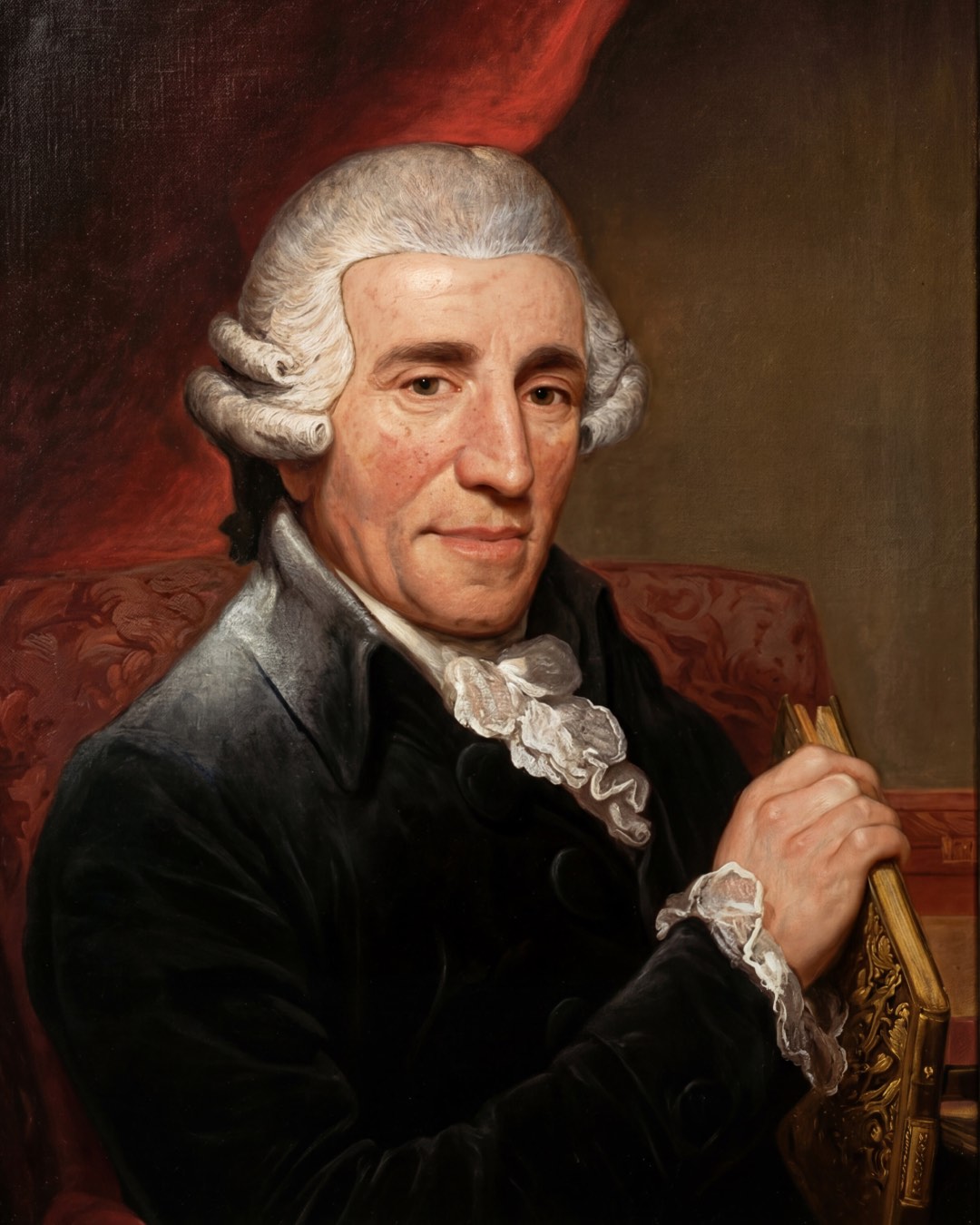
Joseph Haydn was born on 31 March 1732 in Rohrau, a small village in what is now Austria. The son of a wheelwright, he showed an early aptitude for music and joined the choir of St Stephen’s Cathedral in Vienna as a child. After his voice changed, he supported himself as a freelance musician, teacher and composer, gradually building a reputation through determination, practical experience and an exceptional gift for musical invention.
A decisive moment came in 1761, when Haydn entered the service of the wealthy Esterházy family. He spent nearly three decades working at their court, eventually becoming its senior musical director. With a resident orchestra and access to skilled performers, he had the opportunity to experiment, develop new ideas and refine his compositional technique. This period produced a remarkable body of work, including numerous symphonies, string quartets, concertos and operas. His music combined clarity of structure and melodic elegance with unexpected harmonies, playful surprises and moments of profound emotional intensity.
Haydn became particularly influential in the development of the symphony and string quartet. Although he did not invent either form, he helped establish their characteristic structures and expressive possibilities, earning him the enduring titles of the “Father of the Symphony” and the “Father of the String Quartet”. His inventive approach to musical conversation, thematic development and orchestral colour helped define the Classical style.
His friendship with Wolfgang Amadeus Mozart was founded on mutual admiration, and the two composers influenced one another's music. Haydn also taught Ludwig van Beethoven during the younger composer's early years in Vienna, helping to connect the first and second generations of the Classical tradition.
Following the death of his patron Prince Nikolaus Esterházy in 1790, Haydn enjoyed greater independence and travelled to London, where his symphonies were enthusiastically received. These visits inspired some of his most celebrated orchestral works, including the final twelve symphonies, commonly known as the London Symphonies. In his later years, he turned increasingly to large-scale choral composition, producing the acclaimed oratorios The Creation (1798) and The Seasons (1801).
Haydn died in Vienna on 31 May 1809, having achieved international recognition during his lifetime. His music remains admired for its inventiveness, craftsmanship, humour and humanity, and his influence continues to be felt throughout the orchestral, chamber and choral repertoire.