Robert Schumann
Robert Schumann was a leading composer of the Romantic era, celebrated for his expressive piano music, lyrical songs, richly imaginative orchestral works and deeply personal approach to musical storytelling.
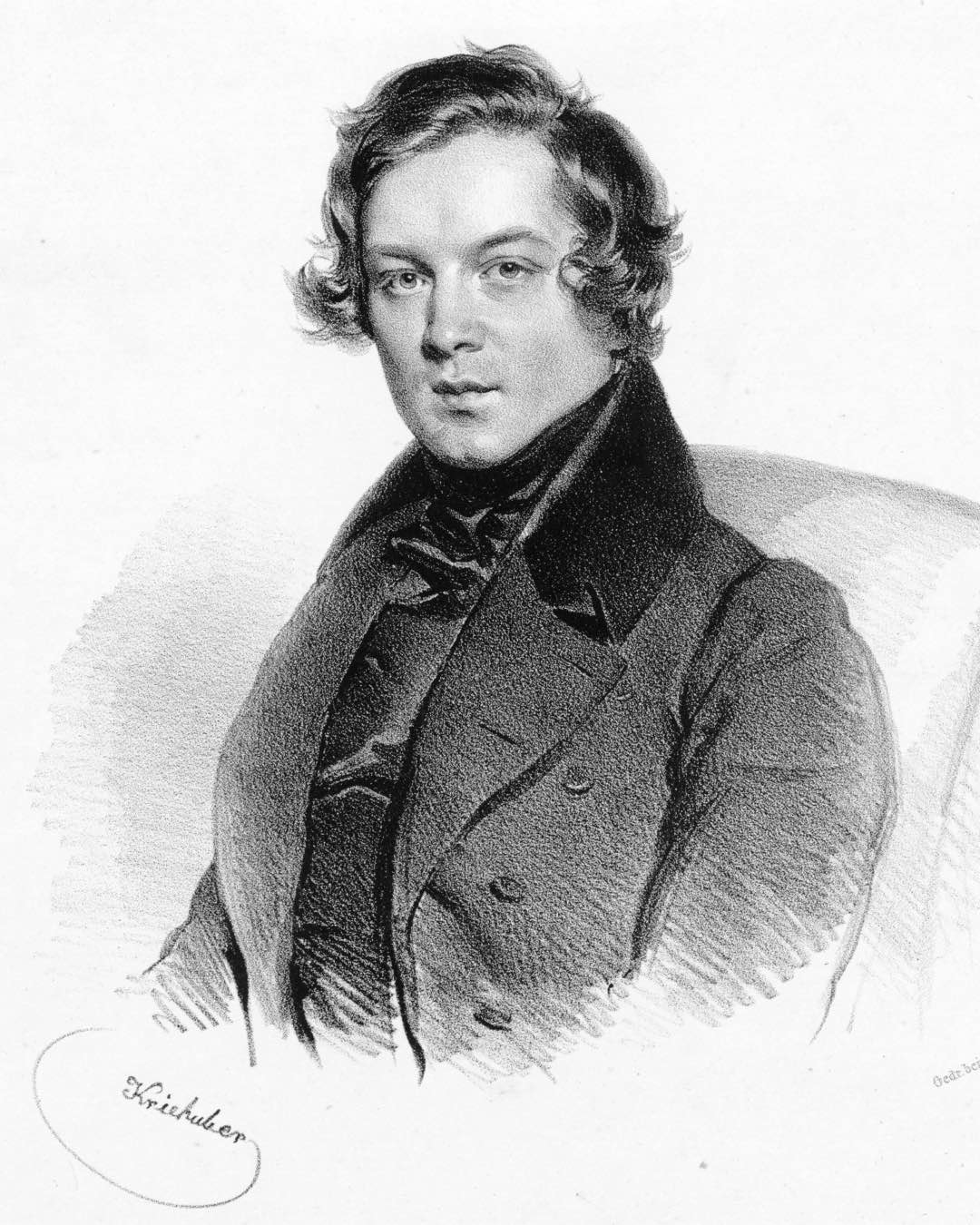
Robert Schumann was born on 8 June 1810 in Zwickau, Saxony, in what is now Germany. The son of a bookseller and publisher, he developed an early fascination with literature as well as music. These two passions would remain closely intertwined throughout his life, inspiring a musical language notable for its poetic character, vivid imagery and psychological depth.
Schumann initially pursued piano studies with the ambition of becoming a virtuoso performer. However, an injury to his hand curtailed his hopes of a concert career, and he devoted himself increasingly to composition. His early masterpieces were predominantly piano works, including Carnaval, Kinderszenen (Scenes from Childhood) and Kreisleriana. These imaginative collections transformed short piano pieces into intimate musical narratives, full of shifting moods, sudden contrasts and literary associations.
In 1840, a year often called his Liederjahr (year of song), Schumann composed an extraordinary number of songs, including the celebrated cycles Dichterliebe (A Poet’s Love) and Frauenliebe und -leben (A Woman’s Love and Life). His songs reveal his gift for combining expressive vocal melodies with piano accompaniments that contribute their own emotional commentary.
That same year, after a prolonged legal struggle with her father, Schumann married Clara Wieck, an exceptional pianist who was already established as a major musical figure. Their marriage became one of the most significant creative partnerships in nineteenth-century music. Clara championed Robert’s compositions throughout her performing career, while their shared musical interests enriched both their artistic lives.
Schumann broadened his compositional ambitions during the following years. In 1841, he explored orchestral writing, producing his First Symphony and the work that became his Fourth Symphony. In 1842, he concentrated on chamber music, composing three string quartets and the Piano Quintet in E-flat major, Op. 44, a landmark of the chamber repertoire. His later orchestral works include the Second and Third Symphonies, the latter known as the Rhenish Symphony, inspired in part by the landscape and spirit of the Rhineland.
Schumann was also an influential critic. Through the Neue Zeitschrift für Musik, the music journal he helped establish, he championed imaginative new music and advocated composers such as Frédéric Chopin and Johannes Brahms. His criticism reflected his belief that music should combine artistic integrity with poetic expression.
In 1850, Schumann became municipal music director in Düsseldorf, although his final years were increasingly troubled by serious mental and physical illness. In 1854, following a severe crisis, he entered an institution at Endenich, near Bonn, where he remained until his death on 29 July 1856, aged 46.
Today, Schumann is recognised as one of the defining voices of musical Romanticism. His works unite lyrical beauty, formal ingenuity and emotional complexity, offering listeners music that feels at once intensely personal and universally human.