Gabriel Fauré
Gabriel Fauré was a pioneering French composer whose elegant melodies, subtle harmonies and deeply expressive music helped shape the development of French music from the Romantic era into the twentieth century.
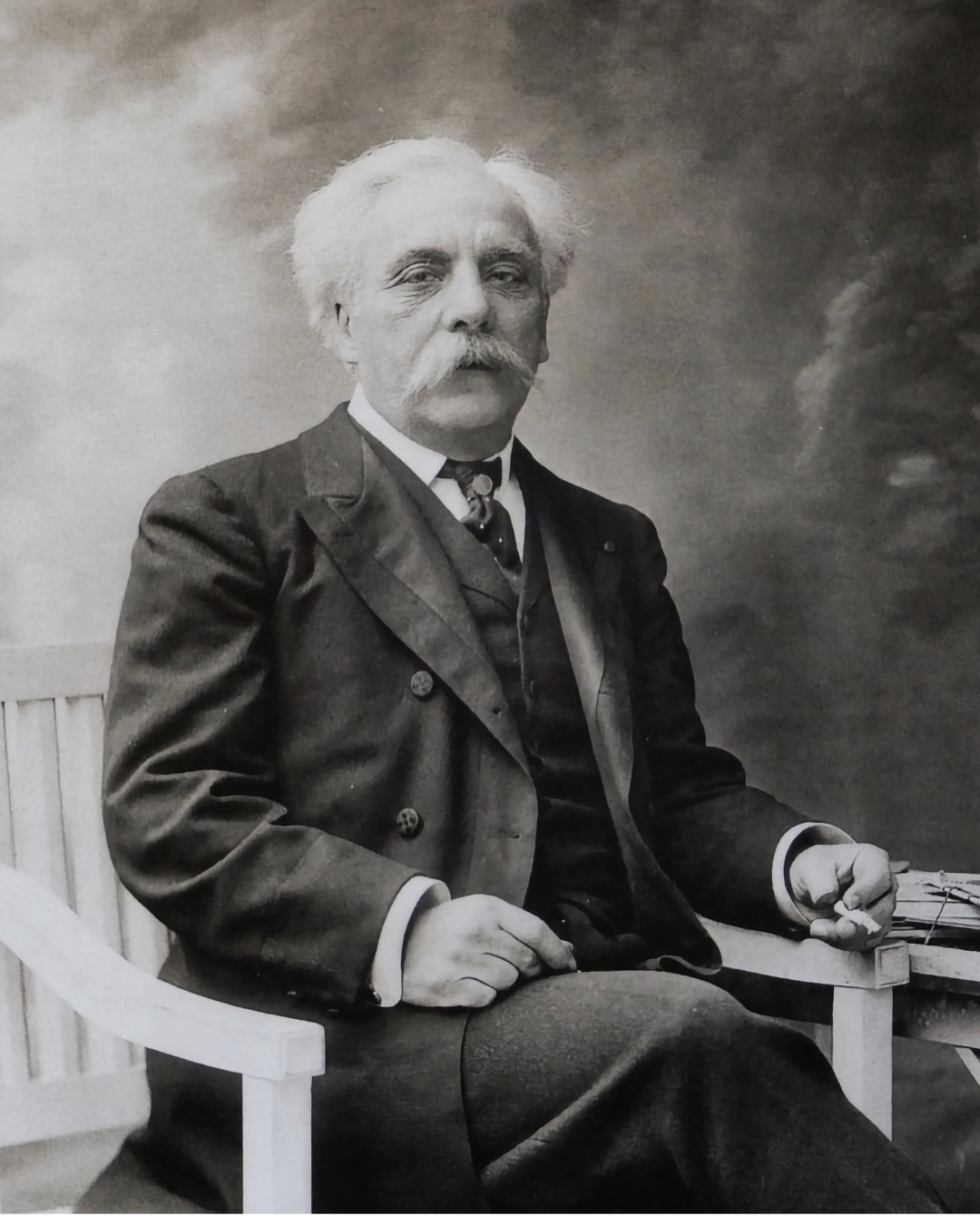
Gabriel Fauré was one of the central figures in French music between the Romantic and modern eras. Celebrated for his lyrical melodies, subtle harmonic language and extraordinary sensitivity to mood and colour, Fauré developed a distinctive musical voice that influenced generations of French composers, including Maurice Ravel, Nadia Boulanger and Charles Koechlin.
Born in Pamiers in south-west France, Fauré showed an early talent for music. At the age of nine he was sent to Paris to study at the École Niedermeyer, a school specialising in church music. There he studied piano, organ, counterpoint and composition, and became a pupil of the composer Camille Saint-Saëns, who recognised his abilities and became a lifelong friend and supporter.
Fauré's early career was closely connected with the church. He worked as an organist in Rennes before returning to Paris, where he held a succession of important church appointments, eventually becoming organist at the Église de la Madeleine. Alongside his professional duties, he established himself as a composer, pianist and teacher. His early works included songs, piano pieces, chamber music and sacred compositions such as the Cantique de Jean Racine, written in 1865 when he was only 19.
Unlike some of his contemporaries, Fauré was not primarily drawn to large-scale orchestral spectacle. His music often derives its expressive power from melody, harmony and subtle changes of colour rather than dramatic contrast. The piano played a particularly important role in his output, inspiring thirteen Nocturnes, thirteen Barcarolles and numerous other works. His songs, or mélodies, are equally important, combining finely judged vocal lines with sophisticated piano writing and an exceptional sensitivity to French poetry.
Fauré's chamber music forms another major part of his legacy. His violin and cello sonatas, piano quartets, piano quintets and string quartet demonstrate his ability to create intense musical expression within relatively intimate forces. His harmonic language gradually became more adventurous, often moving away from the conventional expectations of nineteenth-century tonality while retaining an underlying sense of elegance and balance.
His best-known sacred work, the Requiem, was composed over a number of years and first performed in an early form in 1888. Fauré later revised and expanded it, producing the version most commonly performed today. Unlike many settings of the Requiem Mass, Fauré's work largely avoids images of terror and judgement, instead emphasising peace, consolation and eternal rest. This characteristic preference for serenity over drama can already be heard in the much earlier Cantique de Jean Racine.
Fauré also played an important role in French musical life. He taught composition at the Paris Conservatoire and became its director in 1905. During his tenure he modernised aspects of the institution's teaching and broadened its musical outlook. His pupils included some of the most important French musicians of the next generation, and his influence extended well beyond the works he composed himself.
The later years of Fauré's life were marked by increasing hearing loss. His deafness became severe, making it progressively difficult for him to hear accurately across the full range of musical frequencies. Rather than ending his creative life, however, this limitation coincided with a remarkable late flowering. His late works, including the two Cello Sonatas, Piano Trio, Piano Quintet No. 2 and String Quartet, display an increasingly concentrated and individual harmonic language.
Fauré died in Paris in 1924. His career spanned a period of extraordinary change in French music, from the world of Saint-Saëns and César Franck to the emergence of Debussy and Ravel and the beginnings of musical modernism. Yet his own music occupies a distinctive position between these worlds. Elegant but never merely decorative, restrained yet deeply expressive, Fauré's music rewards close listening for its subtle harmonic movement, beautifully shaped melodies and profound emotional understatement.
Today, Fauré is regarded as one of the great masters of French music. From the youthful Cantique de Jean Racine to the remarkable works of his final years, his music reveals a composer whose greatest effects are often achieved through economy, refinement and quiet intensity rather than sheer volume or spectacle.